



You might be feeling pulled in two directions. On one hand, you started or joined a nonprofit because you care deeply about a cause. On the other hand, you now find yourself staring at spreadsheets, grant budgets, and IRS forms, wondering when you accidentally became a part-time accountant instead of finding a trusted Laredo, TX tax preparer for business to handle the financial side.
Maybe a board member just asked for cleaner reports. Maybe a funder is requesting detailed expense breakdowns. Or maybe you received a letter from the IRS, and your stomach dropped. You are not alone. Many nonprofit leaders feel that same mix of purpose and pressure, especially around money and compliance.
Here is the short version. You do not have to figure this out by yourself. Nonprofit accounting support from an experienced firm can help you stay compliant, earn donor trust, and understand your numbers well enough to make calm, confident decisions, instead of reacting to every financial surprise.
So, where does that leave you right now? It starts with understanding why nonprofit finances feel so heavy, and how the right accounting partner can quietly carry a lot of that weight with you.
Why does nonprofit financial management feel so hard?
Nonprofit money is different. It is not just about profit and loss. It is about restrictions, accountability, and public trust. That difference is what makes accounting services for nonprofits feel more complex than a typical small business, even if your budget is modest.
Think about a few of the pressures you might be feeling.
You might be juggling restricted and unrestricted funds. A donor gives you money for youth programs only, another grant covers operations, and a third pays for a specific pilot project. You know that spending those dollars incorrectly could damage relationships or even trigger repayment. Yet your current system might be one spreadsheet with color codes, and you hope it is enough.
You might be worried about IRS rules. Maybe you have heard of Form 990, public disclosures, and documentation requirements, but you are not sure what applies to you. The IRS provides guidance for public charities in resources like Publication 4221-PC, and has detailed recordkeeping requirements for exempt organizations. These are helpful, yet they can still feel overwhelming when you already have a full plate.
You might also be trying to reassure your board and donors. Board members want clear financial statements. Donors want to know their gifts are used as promised. Staff want to know if their jobs are secure next year. If your reports are late, confusing, or inconsistent, everyone feels more anxious, including you.
So the tension builds. You care about doing this right, but you do not have time to become a technical expert. That is exactly where an accounting firm can step in.
How can an accounting firm steady your nonprofit’s finances?
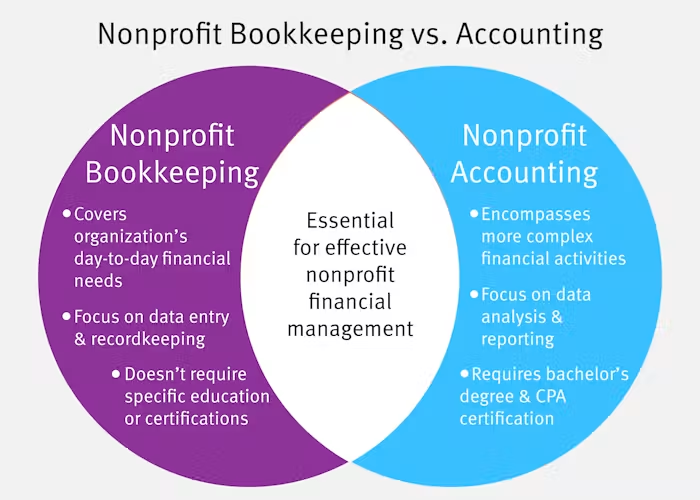
Nonprofits often imagine that accounting help just means “someone to do the books.” In reality, a firm that understands nonprofit financial management support can serve as a guide and a safety net.
First, they translate rules into plain language. An experienced accountant can pull out what matters for your size and type of organization, such as which schedules you must file, what public disclosure means for you, and how to present your mission and programs clearly in the return.
Second, they help you design a chart of accounts and systems that match your reality. Imagine that you run an after-school program with three funding streams. A good accounting firm can set up your accounting software so you can track each grant, allocate payroll correctly, and see in real time how much remains in each funding bucket. Instead of guessing, you can answer questions like “Can we hire another part-time tutor?” with actual numbers.
Third, they build controls and habits that reduce risk. This might include separating duties so the person who writes checks is not the same person who reconciles the bank account, setting approval limits, and creating a simple month-end checklist. These steps protect your organization from errors and fraud, and they also protect you personally from accusations of mismanagement.
If you work with a private foundation, the rules shift again. The IRS has specific guidance on the lifecycle of a private foundation, including excise taxes, payout requirements, and self-dealing rules. A nonprofit accounting firm that understands foundations can keep you on the right side of those rules, so you can focus on your grantmaking instead of tax traps.
So, the question becomes less “Do we need help?” and more “What kind of help will actually lower our stress and improve our decisions?”
Should you DIY or hire a nonprofit accounting firm?
You may be torn between hiring a professional firm and keeping everything in-house. The choice is not always obvious, especially when budgets are tight. The comparison below can help you see where an accounting firm adds the most value.
| Area | DIY / In-house Only | Working with an Accounting Firm |
|---|---|---|
| Compliance with IRS rules | Heavily dependent on one person’s knowledge. Higher risk of missed deadlines or errors on Form 990. | Access to staff who monitor IRS updates and apply guidance like Publication 4221-PC and Form 990 instructions correctly. |
| Grant and restricted fund tracking | Often managed in spreadsheets. Higher chance of misallocations and difficulty answering funder questions. | Structured accounting system that tracks restrictions by grant or program and produces clear reports for funders. |
| Financial reporting for board and donors | Reports may be delayed or unclear. Meetings focus on “what happened” instead of “what should we do next.” | Timely, consistent reports. The board can focus on strategy, reserves, and risk instead of basic clarity. |
| Staff workload and burnout | Executive director or program staff juggle finance tasks on top of core responsibilities. | Finance tasks shared with experts. Leadership gets time back for fundraising and mission work. |
| Cost and flexibility | Lower cash cost if you rely on volunteers or one part-time bookkeeper, but higher risk if that person leaves. | Predictable fees, scalable support, and less disruption when individuals change roles. |
There is no single right answer for every organization. Yet if you notice rising anxiety around compliance, confusion in your reports, or heavy dependence on one person’s knowledge, those are strong signs that professional nonprofit accounting support could be worth the investment.
Three practical steps you can take right now
- Map your most fragile points
Take 15 minutes to write down where you feel most exposed. Is it your IRS filings, grant reporting, cash flow forecasting, or internal controls? Ask yourself, “If our bookkeeper left tomorrow, what would we lose that only they understand?” This quick exercise shows you where an accounting firm could give you the most immediate relief.
- Align your records with IRS expectations
Even before hiring help, you can start aligning your documentation with IRS guidance. Check whether you are consistently saving key documents like grant agreements, donor restriction letters, board minutes, and backup for major expenses. You do not need perfection overnight. Aim for small, steady improvements.
- Clarify what you want from an accounting firm
Before you reach out for help, list what you actually want. For example, monthly reconciliations, clean financial statements for the board, preparation and filing of Form 990, grant and restriction tracking, or guidance on internal controls. Decide whether you want them to handle day-to-day bookkeeping, higher-level oversight, or both. This clarity will help you choose a firm that truly understands nonprofit accounting support, rather than a general small business service that may not grasp your unique needs.
Moving forward with more confidence and less financial stress
You do not need to become a finance expert to lead your nonprofit well. You need enough clarity to make sound decisions, enough structure to satisfy the IRS and funders, and enough support so that money questions do not keep you up at night.
An experienced accounting firm can help you build that structure. They can translate complex rules into simple steps, organize your systems so you can see your true financial position, and stand beside you when the IRS, your board, or a major funder has questions.
You have already done the hard part, which is caring enough to worry about getting this right. The next step is finding the right partner so you do not have to carry that worry alone.


