

You might be feeling a little caught off guard right now. Maybe you lost a tooth a while ago and thought the worst part was the gap in your smile, but now you are noticing changes in your face that you did not expect. A dentist in Great Falls can help you understand why these changes are happening and what can be done. Your cheeks look a bit more sunken. Your bite feels different. You may even feel older than you are when you look in the mirror.end
That can be scary. It is not just about a missing tooth anymore. It is about how you look, how you eat, and how confident you feel when you talk or smile. Because of this, you might wonder if anything can actually protect your jaw and face, not just “fill the space.”
Here is the short version. When a tooth is lost, the bone that once held it begins to shrink. Over time, this can change your facial shape. Dental implants and facial bone loss prevention go hand in hand, because implants act like artificial roots. They stimulate the jawbone and help keep it strong, which can protect your facial structure and your smile for the long term.
Why does bone deteriorate after tooth loss, and why does it affect your face?
To understand what is happening, picture your jawbone as living tissue that needs regular “exercise.” Every time you chew, your tooth roots press into the bone. That pressure tells your body to keep that bone strong and healthy. When a tooth is removed or lost, that signal stops in that area.
Without that signal, your body slowly reabsorbs the unused bone. This is called bone resorption. According to clinical overviews on dental implantology and bone physiology, this process is normal, but it becomes a problem when too much bone disappears.
At first, you might not notice much. Then, as months and years pass, the jawbone under the missing tooth shrinks. If several teeth are missing, the entire ridge of bone can thin out. Because your lips and cheeks rest on that bone, your face can start to look more collapsed, your chin can look closer to your nose, and fine lines can deepen around your mouth.
So where does that leave you if you already have missing teeth, or you are facing an extraction soon?
How do dental implants actually help protect your jaw and facial structure?
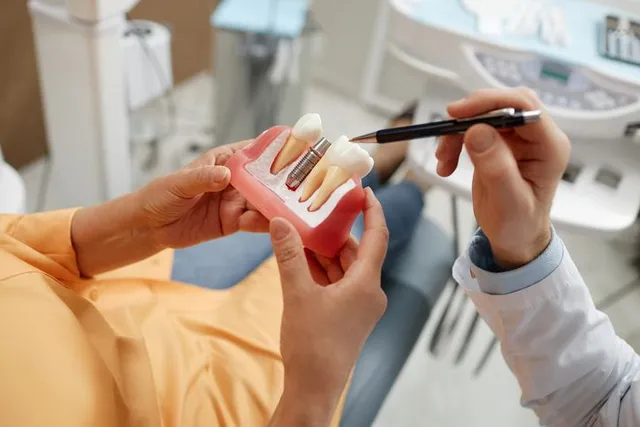
This is where tooth replacement with implants stands apart from other options. A dental implant is a small titanium post that is placed in the jaw, in the same area where your tooth root used to be. Over time, your bone grows around that post in a process called osseointegration.
Once that bond forms, the implant works like a new root. When you bite and chew, the force travels through the implant into the bone. That mechanical stress tells the bone to stay dense and strong in that area. The United States Food and Drug Administration has a helpful overview of how dental implants function and what you should know about them. The key idea is that they are designed to be a long term foundation for replacement teeth, not just something that sits on top of your gums.
Compare that with a traditional bridge or a removable denture. Those options sit above the gums. They can restore your ability to chew and smile, which matters, but they do not send that same “use it or lose it” signal to the bone underneath a missing root. Over time, the bone in those areas can still shrink.
So when people talk about dental implants to prevent bone loss, they are really talking about this root-like function. By keeping the bone engaged, implants help maintain the height and width of your jaw, which supports your lips and cheeks and helps preserve the shape of your face.
What does this look like in real life?
Imagine two different people who both lose a lower molar in their 40s.
Person A decides not to replace it. At first, they adjust their chewing. A few years later, the bone in that area has shrunk enough that the nearby teeth start to tilt slightly. Food packs in more easily. Cleaning becomes harder. Over a decade or more, they notice a subtle hollow along the jawline on that side.
Person B chooses an implant soon after the extraction. The implant integrates with the bone, and a crown is placed on top. They chew normally on that side. The bone receives regular stimulation, so it stays closer to its original volume. Their bite remains more stable, which also protects other teeth from shifting.
Neither path is “wrong,” because every situation has its own medical, financial, and emotional pieces. The question is which trade offs feel acceptable to you, and what matters most to your long term comfort and appearance.
Comparing options for missing teeth and bone preservation
When you are trying to decide what to do next, it helps to see how the main choices differ. Here is a simple comparison of common tooth replacement approaches and how they affect bone and facial structure.
| Treatment option | Bone preservation | Impact on facial appearance | Typical stability and chewing strength | Other points to consider |
| Dental implant with crown | High. Stimulates bone like a natural root and slows bone loss in that area. | Helps maintain natural facial support over time. | Often closest to a natural tooth. Strong and stable. | Requires surgery and healing time. Usually higher upfront cost, but long lasting when cared for. |
| Traditional fixed bridge | Low under the missing tooth area. Some support from neighboring roots, but no direct stimulation where the tooth was lost. | Can look very natural at first, but bone under the gap can still shrink slowly. | Good chewing function. Fixed in place. | Requires reshaping adjacent teeth. May need replacement after several years. |
| Removable partial denture | Minimal. Does not replace the root, so bone loss continues under missing teeth. | Can fill spaces and improve appearance, but long term bone changes may affect fit and facial shape. | Chewing strength is lower than implants or bridges. Can move slightly. | Lower upfront cost. Needs periodic adjustments or replacement as bone changes. |
| Do nothing (leave the gap) | None. Ongoing bone resorption in the area of the missing tooth. | Over time, more visible changes to jawline and lower face, especially with multiple missing teeth. | Chewing on that side is reduced. Other teeth may shift. | No immediate cost, but higher risk of future dental issues and more complex treatment later. |
If you want a broader picture of how implants fit into general treatment planning, the University of Illinois at Chicago has a patient friendly guide to dental implants as a popular option for tooth replacement that explains how they compare with other choices.
What should you do now if you are worried about bone loss and your face shape?
Feeling anxious is normal here. You are trying to make a long term decision about your health, your appearance, and your budget. Instead of trying to solve everything at once, it can help to focus on a few clear next steps.
- Get a thorough evaluation with imaging, not just a quick glance
Ask a general and implant dentist to take detailed X rays or 3D scans of your jaw. This shows how much bone you still have, where it is strongest, and whether there are early signs of bone loss in other areas. With that information, the dentist can tell you if an implant is realistic now, or if bone grafting or another approach would be needed first.
Do not hesitate to ask the dentist to show you the images and explain what they see in plain language. You deserve to understand what is happening in your own mouth.
- Talk openly about your priorities, not just your teeth
Some people care most about keeping their face looking as youthful and natural as possible. Others are focused on being able to eat comfortably. Many are worried about cost or medical conditions that might affect healing. All of that matters.
Tell your dentist what scares you the most and what you hope your life looks like 5 or 10 years from now. A thoughtful treatment plan for dental implant therapy should line up with your real life, not just what looks good on a chart.
- Ask for a clear, step by step plan and timeline
Implants are not a same day fix. There is surgery, healing, and then the final crown or restoration. Ask for a written outline of the stages, the healing times, and the approximate costs at each stage. If bone grafting is needed to rebuild areas that have already shrunk, ask how that changes the timeline and the likelihood of success.
Knowing the steps in advance can lower your stress and help you plan emotionally and financially, instead of feeling rushed or pressured.
Moving forward with more clarity and less fear
You do not have to accept ongoing bone loss and facial changes as something you are powerless to stop. Understanding how implants help protect your jaw gives you more control over what happens next.
Whether you choose implants now, consider them later, or decide on another path, you deserve care that respects both your health and your sense of self. A good general and implant dentist will not just talk about teeth. They will talk about your confidence, your comfort, and how you want to feel when you look in the mirror years from today.
You have already taken a meaningful step by learning how How Dental Implants Help Prevent Facial Bone Deterioration. The next step is to sit down with a trusted dental professional, ask your questions without holding back, and choose the path that feels right for you.
